
In this article, you'll learn about Confidently Held Misinformation and the need to correct it.
For more information on writing questions, check out:
Identifying CHM
Confidently held misinformation, or CHM, is the information with think we know but we actually don't. CHM is a big problem for companies because when we are confident about our knowledge, we act. When we are confident and wrong, we make mistakes—and potentially cause great harm.
Common mistakes are an important consideration when you draft questions in Amplifire because it is a learning tool, not an assessment tool. To maximize learning, you must ensure that each incorrect answer (distractor) is truly incorrect, while still highlighting a learner’s CHM by presenting answer options that learners think are true but aren’t. From there, Amplifire uses a sophisticated algorithm backed by cognitive science to identify and correct CHM.
For example, in the question below, pulled from Amplifire's author training course, the correct answer is selected. The two distractors are questions trainers frequently receive. In fact, a third of learners selected them as the correct answer.
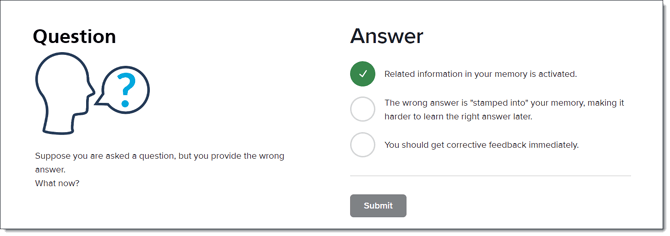
Consider common mistakes as you draft your questions, tagging them in the questions to keep you on track with your learning goals.
To identify CHM, consider:
- Common misconceptions
- Everyday mistakes on the job
- Frequent questions in class
- Outdated information
- Potentially harmful errors of omission
Correcting CHM
Keeping in mind that Amplifire is a learning tool, when learners inevitably select the answers that they believe are correct but aren't, they will see the What You Need to Know in their learning burst. For that reason, it's important to focus the WYNTK. Use it to:
- Provide reinforcement of “why” the correct answer is correct
- Correct confidently held misinformation by explaining why plausible distractors are wrong
- Address ambiguity
- Include images that illustrate key points
- Use links to source material to support relevant details
For more information on writing quality questions, check out: