
The Theory Behind the Platform
Putting some of these theories to work as you draft questions will help you elevate your learners' experience. Consider these elements:
- Three levels of questions
- Priming, not testing
- Less is more
- Order and randomness
- Trick questions vs. tricky questions
- Effective question stems
- Incorrect answers (distractors)
- The trap of perfectionism
Three Levels of Questions
There are three types of Amplifire questions:
- KNOW: Learners usually memorize the correct answer to KNOW questions. These brief questions provide limited context and do not use scenarios or introductions. Question stems most often begin with “Who”; “What”; “When”; and “Where”, seldom with “Why” or “How.”
- UNDERSTAND question stems most often begin with “Why” or “How” and sometimes use a scenario introduction.
- APPLY/PRACTICE questions provide information in the form of a scenario or other introductory material, then ask learners to make a decision (an action, evaluation, or prediction) about that information. Regardless of their phrasing, question stems are usually brief and do not themselves contain topical information.
Priming, Not Testing
Amplifire uses priming, the process of asking questions first and teaching later. This may sound unfair, but it isn’t. Asking learners to answer questions about subjects they’re not familiar with primes their brains to learn quickly when the information is actually taught to them.
In other words, it’s okay to ask learners questions they don’t know the answers to…yet. If they answer incorrectly, they’ll see the Explanation, which will teach them all they need to know to answer the question correctly the next time they see it.
What this means:
- Don’t try to teach the learner the concept in the Question Stem or Intro. Just ask the question.
- Teach in the Explanation.
Less is More
Time is money. Learners have busy schedules and don’t have hours to spend sitting in front of a screen answering questions. Furthermore, your learners may not find your content as thrilling as you do. They don’t want to read a novel as they go through Amplifire, so don’t overload them, and make your content as interesting as possible.
What this means:
- Focus on the most important concepts.
- Don’t ask ten questions when three will do.
- Keep your content brief, especially Explanations (recommended 90–120 words).
- Judiciously use graphics, videos, and dynamic content.
Order and Randomness
The Amplifire algorithm weighs a learner’s previous responses and other factors to determine question order within a module. This means that no two learners will see questions in the same order.
Similarly, answer choices are ordered randomly: The first time a question appears, answer choice “A” might be at the top of the list, and the second time that question shows up, answer choice “A” might be at the bottom.
What this means:
- Don’t refer to other questions (i.e., In the previous question…).
- Don’t use answer choices that assume a set order (i.e., all of the above, none of the above).
Trick Questions vs Tricky Questions
Your goal isn’t to trip up the learner with red herrings and trick questions. This will cause frustration and impede learning.
At the same time, expect contentiousness. Learners will likely disagree with some information you present in your course. This isn’t bad; it’s actually very good. When emotion is involved, learners will learn quicker and retain their knowledge longer.
What this means:
- Get to the point. Present only necessary information in your Question Stems and Intros
- Don’t be afraid to address controversial concepts
Effective Question Stems
Writing effective question stems is a way to promote and test higher-order thinking and cognition as defined by Bloom’s taxonomy. Use these guidelines to create effective question stems that help the learners achieve a higher level of thinking and learning:
- Write question stems such that the phrase “Do you know…” could precede it without impacting its grammar or sense
- Have the question stem contain all the information necessary to understand the problem or question
- Write the stem in the form of a question rather than a statement
- Limit using negatively stated stems
- Write the stem clearly, simply, and to the point
- Avoid the use of unnecessarily complex words – focus on testing understanding of learning objectives versus reading comprehension level
- Avoid using information that gives away the correct answer
- Always keep in mind the purpose of the question and how it relates to learning objectives
- Align the stem with a learning objective
- Ensure that your grammar and spelling is correct
Although these guidelines apply in most cases, it is important to note that there are exceptions and authors need to be flexible when using these guidelines and always keep in mind what is best for the learner.
Incorrect Answers (Distractors)
Amplifire questions promote long-term memory creation. Learners must examine each answer choice, compare and contrast it, and accept or reject it. Incorrect answers—distractors—provide a frame of reference for the question and opportunities to address errors and Confidently Held Misinformation (CHM).
As you begin drafting the distractors, consider:
- Common misconceptions
- Everyday mistakes on the job
- Frequent questions in class
- Outdated information
- Potentially harmful errors of omission
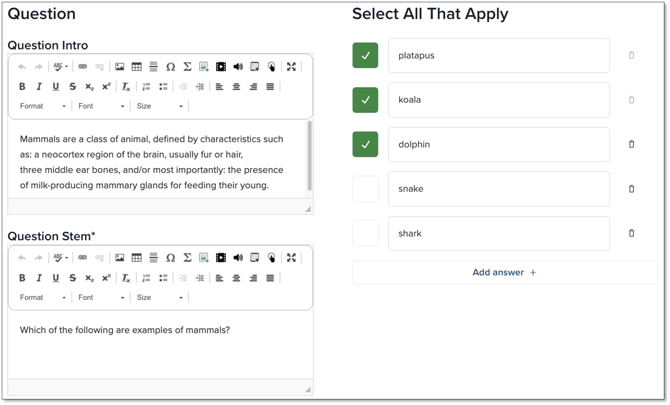
In the following example, a koala is a straightforward example of a mammal. However, many people disqualify platypus as mammals since they do not give birth to live young, or dolphins because they seemingly have no hair and are phenotypically similar to fish. Those choices are common errors when classifying mammals, where a learner may guess one or neither correctly with koala.
Perfectionism
Designing content in Amplifire should be iterative. Once you’ve rolled out version one, you can use Amplifire analytics to identify possible content problems that need to be addressed in you next version.
What this means:
- Deliver value by rolling out an initial course as quickly as possible
- Plan to revise your course after it has been rolled out to initial learners