
In this article, you'll learn about why learning objectives and topics are important, as well as how to tailor them to your content for meaningful learning and reporting.
To learn more about writing quality content, check out:
 |
TL;DR: This article covers narrowing objectives to observable, decision-based skills (not topics), using action verbs Amplifire can question, then grouping objectives into topics that drive the struggle/misinformation/prior-knowledge reporting signals and GapFinder recommendations. Includes a "so that" test and a topic-sizing rule of thumb (3–5 topics per objective). |
Why Learning Objectives Come First
In most course development workflows, learning objectives feel like a formality. In Amplifire, they are the real work.
Amplifire’s algorithm identifies what each learner does not know, surfaces those gaps through targeted questioning, and uses spaced repetition and interleaving to turn uncertainty and errors into durable understanding. To do this, it needs precise objectives. Vague objectives lead to vague questions that cannot distinguish between what learners truly know and what they only think they know, so they fail to correct previously invisible instances of misinformation.
Clear, well-written learning objectives are the foundation that makes question design, answer rationales, and confidence calibration work as intended.
Start by Narrowing: What Does This Audience Actually Need to Do?
The most common mistake in course development is writing objectives that describe topics rather than skills. "Understand data privacy regulations" is a topic. "Identify which employee actions trigger a mandatory breach notification under HIPAA" is a skill—and it's something you can write a question about.
Before writing a single objective, ask, "what will learners do differently after this course?"
The answer should describe real, observable behavior, not a level of familiarity with subject matter. If you can't picture what "doing it" looks like, the objective isn't narrow enough yet.
A Practical Narrowing Process
Start with the broadest version of what the course covers, then consider:
-
What the course is about
-
Who the course is intended for (this is sometimes determined for you, but don't skip it)
-
The skill you want learners to be able to use
- The ideas you'll need to cover to teach that skill
| Level | Example |
|---|---|
| Course Topic (the overall box) | Cybersecurity awareness |
| Audience (specific, primary group) | Non-technical office staff in a mid-sized corporation. |
| Skill (Learning Objective) | Distinguish a phishing email from a legitimate IT communication based on sender address, link destination, and urgency language. |
| Concept (Topics) |
• Types of phishing |
Approaching a course within the structure above and creating everything within that structure provides you with both learning objectives and topics.
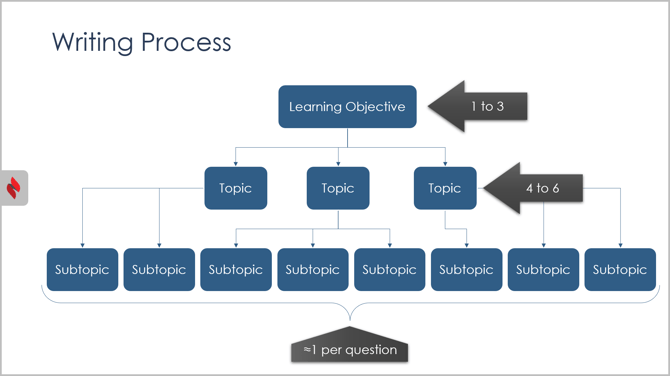
However, we must also caution you against making your learning objectives too narrow. A standard 25-question module shouldn't have more than three or four learning objectives. The learning objective narrows from the overall subject of your course, and topics narrow further from there, with the subject of each individual subject narrowing still further. Check out the (admittedly shortened) example below.
For more information on creating your course structure, check out:
Ask the "so that" Test
Take any draft objective and add "so that..." at the end. If you can't complete the sentence with something meaningful and job-relevant, the objective needs more work.
"Learners will understand our expense reimbursement policy..." "...so that they can..." — submit compliant expense reports without manager corrections? Catch out-of-policy submissions before approving them?
The "so that" completion often reveals the real objective hiding inside the vague one.
Writing Objectives that Amplifire's Algorithm Can Use
Amplifire works through questions. That means every learning objective you write will eventually need to become one or more items that probe whether a learner actually knows the thing — not just whether they've seen it. This shapes how objectives should be written.
Use Action Verbs that Imply a Decision or Judgment
Bloom's Taxonomy is a useful starting point, but the most Amplifire-friendly verbs sit in the middle and upper tiers—the ones that require a learner to do something with knowledge rather than just recall it.
Strong choices for Amplifire include:
- Distinguish, differentiate, classify
- Select, choose, determine
- Apply, calculate, follow
- Identify (when there's something to discriminate between)
- Predict, explain why, justify
Weaker choices (harder to assess through questioning):
- Understand, know, be aware of, appreciate
- Learn, explore, review
- Become familiar with
The test: can you write a plausible wrong answer for this objective? If you can't imagine a credible incorrect response that a real learner might have, the objective is probably too simple or too vague to generate meaningful questions.
Practical Guidance for Common Scenarios
When Your SME Provides a Topic List, Not Objectives
Subject matter experts often think in terms of content areas ("we need to cover the new vendor approval workflow") rather than learning outcomes. While topics are tremendously helpful in Amplifire reporting, those should come from the learning objectives, not replace them.
Help them get specific by asking:
- "What's the most common mistake people make with this?"
- "What does someone who understands this do that someone who doesn't won't do?"
- "What decision would a learner face in their job where knowing this matters?"
Their answers will usually contain the objective you need.
When the Course Covers a Topic
Broad compliance courses are tempting to write at the topic level ("employees will understand the Code of Conduct") because the content is mandated and the audience is everyone. Resist this. Even a company-wide compliance course benefits from objectives tied to specific decisions employees face.
Rather than one objective per policy section, ask: What are the three situations where employees most commonly get this wrong? (Hint: this is CHM!) Write objectives around those scenarios. A narrower scope improves both the quality of questions and the likelihood that learners will transfer the knowledge to their actual work.
Note: When content must be delivered to multiple audiences who don't all need to know all of the topics in a course, consider using Attribute-Based Learning to accommodate a broader audience.
When a Course Must Cover Foundational and Applied Knowledge
Some topics genuinely require building foundational knowledge before applying it. In Amplifire, this is fine—but keep the two levels clearly separated in your objectives so they can be questioned differently.
- Foundational objective: "Identify the four components of a valid contract."
- Applied objective: "Determine whether a described scenario constitutes a binding contract based on the presence or absence of each required element."
The applied objective is where Amplifire's adaptive approach adds the most value. Don't skip the foundation, but don't let it crowd out the application.
A Quick Checklist Before You Build
Use this before submitting objectives for content development:
- Each objective describes observable behavior, not familiarity with a topic
- The action verb implies a decision, judgment, or discrimination—not just recall
- A credible wrong answer exists for each objective (the "wrong answer test")
- The objective reflects where real learners actually struggle, not just what the content covers
- The "so that" test produces a meaningful, job-relevant completion
From Learning Objectives to Topics: Building the Reporting Layer
Once your learning objectives are solid, the next step is grouping them into topics. In Amplifire, topics are more than an organizational convenience—they are the unit of measurement that makes reporting actionable and enables intelligent training recommendations.
What Topics Do in Amplifire
Amplifire uses topics to aggregate performance data across the questions associated with each objective. This produces three reporting signals that help administrators, managers, and instructional designers understand how learning is going:
- Struggle—how hard learners are working to get answers right, even after seeing the content
- Misinformation—how often learners answer with high confidence but incorrectly, indicating a firmly held wrong belief
- Prior knowledge—how much learners already knew before training began
These signals are in the Amplifire Reporting Dashboard, regardless of whether the questions live in a GapFinder or a Dynamic Learning module. In either module type, data showing high misinformation in a specific topic tells you something precise and actionable: learners aren't just unfamiliar with this area—they have a confident misconception that needs to be corrected, not just covered.
Topics are also necessary in the configuration of GapFinders, which can be used to identify topics with high struggle and recommend modules targeting the areas where gaps are highest. For this to work well, topics need to be defined at a granularity that is meaningful enough to distinguish the topics in need of further analysis—not so broad that everything gets lumped together, and not so narrow that the signal becomes noisy.
How to Derive Topics from Objectives
The most reliable way to define topics is to work directly from your finished learning objectives. Because objectives are already scoped to a single assessable skill, they naturally suggest topic boundaries.
Start by grouping objectives that share a common knowledge domain. Objectives that draw on the same underlying concept, process, or decision-making context belong in the same topic. Objectives that require meaningfully different knowledge belong in different topics.
For example, consider a course on workplace safety:
| Learning Objective | Topic(s) |
|---|---|
| Identify which spill types require immediate supervisor notification. |
• Spill Types |
| Select the correct PPE for a described chemical exposure scenario. |
• PPE Selection Criteria |
The two objectives both require knowledge of hazardous material protocols, so they have overlapping topics. In reporting, this content can be "sliced" in various ways to learn more about learners' performance and additional needs.
Sizing Topics Correctly
Topic granularity matters because it directly affects the quality of reporting and the usefulness of GapFinder recommendations. Here are the two failure modes to avoid:
Topics that are too broad obscure what's actually happening. If every objective in a course rolls up to a single topic called "Compliance," struggle data has nowhere useful to land. A learner struggling with HIPAA breach notification looks identical in reporting to one struggling with records retention — and neither gap gets surfaced clearly enough to act on.
Topics that are too narrow produce thin reporting. A topic built around a single objective with two or three questions won't generate enough data to produce reliable struggle or misinformation signals. As a rule of thumb, aim for topics that span at least three to five objectives and can support a meaningful number of questions.
A useful sizing check: could someone reading a report on this topic take a concrete action based on what it tells them? If a topic is too broad, the answer is "not without drilling down further." If it's too narrow, the answer is "there isn't enough data to be sure." The right size sits between those two failure points.
Name Topics for the Reporting Audience
Topic names appear in the reporting dashboard that managers can access and make decisions upon. Name them in language that is immediately meaningful to that audience.
Avoid internal jargon, course-structure names ("Module 3 Content"), or abstract labels ("Advanced Concepts"). Instead, use names that describe the skill or knowledge domain in plain terms a manager would recognize.
| Less useful | More useful |
|---|---|
| Unit 2: Regulations | HIPAA Privacy Requirements |
| Advanced Application | Applying Sampling to High-Risk Accounts |
| Background Knowledge | Contract Fundamentals |
A manager reviewing struggle data by topic should be able to look at the topic name and immediately understand what their team is struggling with—without needing to open the course to find out what the topic actually covers.
Topics and GapFinders: Designing for Recommendation
When Amplifire GapFinders are in use, topic-level struggle data can trigger a recommendation to assign a dynamic learning module that covers that topic in further depth. This means the topics you define have implications beyond a single course—they create a connective layer you can use to provide learners with a fast, efficient learning experience.
To get the most value from this capability, align topic naming and scoping consistently across modules that cover related subject matter. If two modules both address "Contract Fundamentals," using that exact label in both allows a GapFinder to recognize that a learner struggling in that topic and assign either a module (using recommended modules) or a set of questions (using dynamic modules) to fill in the gaps in a learner's understanding.
To learn more about GapFinders, check out:
A Topic Development Checklist
Before finalizing topics for a course:
- Each learning objective includes several topics, and each topic is assigned to at least two to three questions—no one-question topics
- Topic names are written in plain language meaningful to a reporting audience
- No two topics in the same course cover the same knowledge domain
- Topic names are consistent with any related modules in the broader curriculum
- Topics are granular enough that struggle in one topic is distinguishable from struggle in another
Strong learning objectives and well-designed topics work together as the structural foundation of any Amplifire course. Objectives define what learners need to be able to do; topics organize that knowledge into units the platform can measure, report on, and act on.
The investment in getting both right before content development begins pays dividends at every stage: sharper questions, cleaner reporting, more useful GapFinder recommendations, and—most importantly—learning that actually changes what people know and do on the job.
A course with three clear objectives each with four to six well-named topics will consistently outperform a course with twenty fuzzy objectives and a single catch-all topic.